ADA, Okla. – On May 1, I took part in a trip to Tulsa organized by East Central University’s chapter of the Sigma Tau Delta International English Honor Society.
I had a great experience, as did the other students that went on the trip. Faculty in the English Department have organized several trips during the 2025-26 school year, the last one also being a trip to Tulsa. That trip involved seeing the Greenwood Rising History Center and the Woody Guthrie Center, whereas the focal point of this experience, planned by Dr. Jeaneen Canfield, was the Philbrook Museum’s Killing the Negative exhibit.
This trip goes hand-in-hand with Dr. Canfield’s class, ENG-4983-01: (Re)Imaging the West.
In class, we learned about Roy Strycker, who was tasked during the Great Depression with leading a group of photographers in their efforts to document the lives of Americans in the rural parts of the country. These photographers included many prominent names, like Dorothea Lange, who would produce the iconic photo of Florence Owens Thompson known as Migrant Mother. While many of the photographs taken by this team have become iconic, Strycker arbitrarily decided that others were not worthy of publication. He punched holes in the photographic negatives that he rejected, thereby “killing” them.
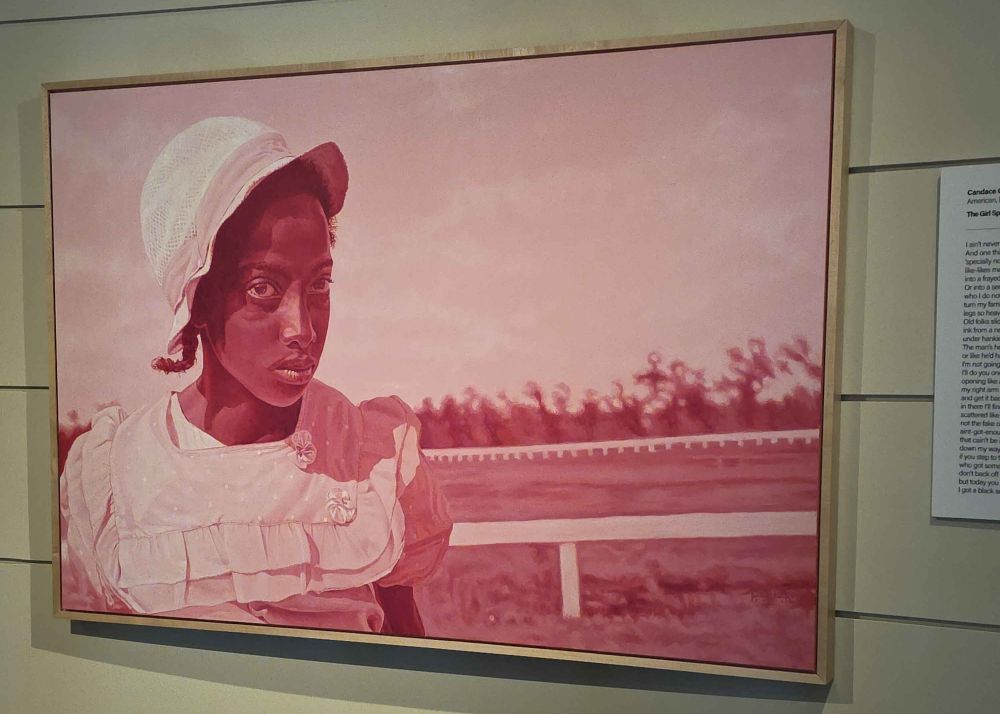
Many decades later, artist Joel Daniel Phillips found these killed negatives and recreated several as large charcoal drawings and paintings. In a collaborative effort, he worked with poets, including EUC’s own Dr. Ken Hada, to create a book that contained both his art and poems inspired by them. Killing the Negative was the result.
In March of 2025, I had the pleasure of listening to Joel Daniel Phillips, Dr. Quraysh Ali Lansana, Dr. Candace G. Wiley, and Dr. Ken Hada talk about the project and recite their poetry here on campus. That panel made me very excited to see Phillips’s actual art in-person, framed alongside their corresponding poems. I was immediately taken by surprise at how large and intricate the framed pieces are. Each one has an amazing story to tell, and each one was given a new voice by the poetry that accompanied them. We were fortunate to have both Dr. Hada and Dr. Lansana (an associate professor at the University of Tulsa) with us in the exhibit. Both powerfully recited their poems and discussed their work on the project, giving us opportunities to ask questions.
I felt very fortunate to have the chance to hear from both, as did my fellow students. I have a better appreciation for a part of our nation’s history that Oklahoma struggled through - in fact, several of the drawings are based on photographs taken in this state. The experience also reminded me of the artistry and creativity that we have access to in Oklahoma and on the ECU campus.
After being guided through the exhibit, our group was then let loose to explore the museum. We saw everything from paintings from the Italian Renaissance to Native American traditional art to modern sculpture. We were also able to meander through the museum’s gardens and take some photos together to commemorate our time there. I have made some of my best friends in the English Department, and this outing made me feel closer with all of them. It would not have been possible without ECU’s support, Dr. Canfield, Dr. Hada, Dr. Lansana, and Elizabeth Ross, who provided the funds for the trip and came to Tulsa along with us.
To me, this trip demonstrated the importance of experiential learning and travel with other students and faculty, even if it only takes place two hours from campus. I look forward to more adventures sponsored by Sigma Tau Delta and the English Department!
-ECU-